A Man's Guide to Finding the Right Support
Navigating the System with Clarity and Confidence
Executive Summary
This guide is for men who feel overwhelmed by the process of seeking mental health and wellbeing support. It provides a clear, structured overview of the different types of services available in Australia, what they do, and when to access them. The aim is to demystify the system, reduce hesitation, and empower men to take the first step toward greater self-awareness, connection, and wellbeing. It moves beyond clinical definitions to offer a practical map that helps men identify the right starting point for their unique situation, whether that involves medical support, therapeutic conversation, personal growth, or community connection.
The Framework: From Hesitation to Action
For many men, the biggest barrier to seeking support isn’t a lack of willingness, but a lack of clarity. When you don’t know where to start, it’s easy to do nothing at all. This hesitation keeps men stuck in cycles of anxiety, stress, and disconnection.
The Men Spirit’s approach is grounded in the belief that clarity is the antidote to hesitation. Our Theory of Change is built on a simple progression: fostering Self-Awareness of one’s inner state, building Connection with the right support, and taking meaningful Action toward wellbeing.
This guide is designed to facilitate that first step. Use this simple anchor to ground yourself:
If I’m not sure, I’ll start with my GP.
If I’m not in crisis, I’ll start with a conversation.
If I need medication, I’ll see a psychiatrist.
If I need therapy, I’ll see a psychologist.
If I need growth and direction, I’ll see a coach or mentor.
Clarity reduces hesitation. Hesitation keeps men stuck.
Below is a detailed breakdown of what each of these roles means in practice, helping you choose the path that aligns with your needs.
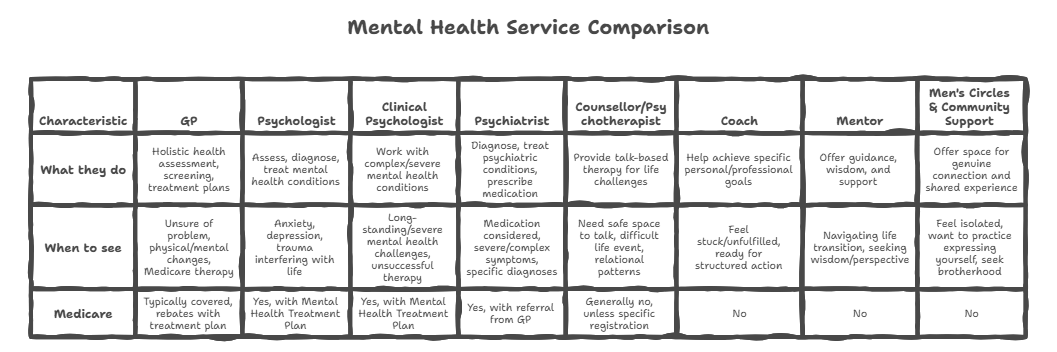
Comparison of Mental Health and Well-Being Services
A Clear Guide to Services
GP (General Practitioner)
• What they do: Your GP is the most practical starting point for your health, both physical and mental. They are trained to look at the whole picture. They can screen for common conditions like anxiety and depression, investigate physical factors that might be contributing to how you feel (such as sleep issues or hormone imbalances), and create a Mental Health Treatment Plan to help you access subsidised specialist services.
• When to see a GP: You aren’t sure what’s wrong, you’ve noticed changes in your physical or mental state, or you want to access Medicare-rebated therapy.
• Medicare: GP visits are typically covered. A Mental Health Treatment Plan provides Medicare rebates for eligible psychologists, social workers, and occupational therapists.
Psychologist
• What they do: Psychologists are trained to assess, diagnose, and treat mental health conditions. They use evidence-based therapeutic approaches (like CBT, ACT, or EMDR) to help you understand and change patterns of thought, emotion, and behaviour.
• When to see a psychologist: Anxiety, depression, or trauma is interfering with your daily life, or you are seeking structured, evidence-based therapy to address specific mental health concerns.
• Medicare: Yes, with a Mental Health Treatment Plan from your GP, you can receive a Medicare rebate.
Clinical Psychologist
• What they do: A clinical psychologist has additional postgraduate training to work with more complex or severe mental health conditions, such as complex trauma, personality disorders, or chronic depression.
• When to see a clinical psychologist: You are dealing with long-standing or severe mental health challenges, or previous attempts at therapy have not been successful.
• Medicare: Yes, with a Mental Health Treatment Plan. The rebate is typically higher than for a general psychologist.
Psychiatrist
• What they do: A psychiatrist is a medical doctor who has specialised in mental health. Their primary role is to diagnose and treat psychiatric conditions, with a strong focus on the biological and neurological aspects of mental illness. They are the only specialists, apart from GPs, who can prescribe and manage psychiatric medication.
• When to see a psychiatrist: Medication is being considered, symptoms are severe or complex, or you have been diagnosed with conditions like bipolar disorder or schizophrenia.
• Medicare: Yes, with a referral from your GP.
Counsellor / Psychotherapist
• What they do: Counsellors and psychotherapists provide talk-based therapy to help you navigate life’s challenges and understand your inner world. They offer a supportive, non-judgmental space to explore your feelings, relationships, and life experiences.
• When to see one: You need a safe space to talk, you are navigating a difficult life event (like grief or a breakup), or you want to understand and change deeper relational patterns.
• Medicare: Generally, no, unless the practitioner holds a specific eligible registration (e.g., Accredited Mental Health Social Worker).
Coach
• What they do: Coaching is a forward-focused process aimed at helping you achieve specific personal or professional goals. A coach does not diagnose or treat mental illness. Instead, they work with you to build self-awareness, identify values, set goals, and create accountability.
• When to see a coach: You feel stuck or unfulfilled but are otherwise functioning well, and you are ready to take structured action toward a specific goal.
• Medicare: No.
Mentor
• What they do: A mentor offers guidance, wisdom, and support based on their own lived experience. The relationship is less structured than coaching and is built on a foundation of shared understanding and trust. They provide a sounding board for navigating specific life domains.
• When to see a mentor: You are navigating a significant life transition (like fatherhood or divorce) and want guidance from someone who has been through it, or you are seeking wisdom and perspective on your career, identity, or life direction.
• Medicare: No.
Men’s Circles & Community Support
• What they do: Men’s circles offer a space for genuine connection and shared experience. They are not therapy, but they can be deeply therapeutic. In a confidential and non-judgmental setting, men can speak openly, listen to others, and feel a sense of belonging.
• When to seek community support: You feel isolated, you want to practice expressing yourself more honestly, or you are looking for a sense of brotherhood and belonging.
• Medicare: No.
Key Takeaways
• Start with your GP: When in doubt, your General Practitioner is the best first port of call. They can assess your overall health and direct you to the right specialist.
• Understand the Difference: Therapy (psychologists, counsellors) is primarily for processing and healing. Coaching and mentoring are for growth and action. Medical support (GPs, psychiatrists) is for diagnosis and medication.
• Medicare is a Key Resource: A GP-led Mental Health Treatment Plan is the gateway to accessing affordable psychological care.
• Community is a Powerful Support: Do not underestimate the power of connection with other men. Men’s circles provide a unique form of support that complements clinical and one-on-one services.
• Action Reduces Anxiety: The simple act of booking an appointment is a powerful step forward. You do not need to have all the answers before you begin.
Closing Note
Seeking support is an act of strength and self-responsibility. It is a commitment to yourself, your family, and your future. Use this guide not as a set of rules, but as a map to help you find your way. The right path is the one you are willing to walk.
For crisis support, please contact Lifeline (13 11 14), MensLine Australia (1300 78 99 78), or emergency services (000).