Understanding Trauma in the Body: A Guide for Men
Emotions (Your Inner Compass)
This guide is a cornerstone of the Emotions (Your Inner Compass) dimension of The Men Spirit Framework. Trauma is not just a story you tell; it is a physiological reality stored in your body. Understanding this connection is the first step to reclaiming your internal landscape. This article provides the “why” behind somatic (body-based) healing, explaining how unprocessed experiences can manifest as anxiety, numbness, or chronic tension. It serves as a foundational piece for building emotional literacy and developing a more compassionate relationship with yourself.
Executive Summary
For many men, the word “trauma” can feel distant or extreme, yet its effects are incredibly common. This guide demystifies trauma by explaining it not as a mental weakness, but as a biological response to overwhelming experiences that gets stored in the body. It explores the science behind why your body “keeps the score” and how unprocessed trauma can manifest as anxiety, chronic pain, emotional numbness, or a constant feeling of being on edge. Most importantly, it offers a hopeful, evidence-based perspective on healing, introducing practical, body-based (somatic) tools that can help you regulate your nervous system and safely reconnect with yourself.

Key Takeaways
Trauma is Physiological: It’s not the event itself, but the body’s unresolved response to the event. Your nervous system gets “stuck” in a state of fight, flight, or freeze.
You Don’t Have to Relive It to Heal It: Modern, body-based therapies focus on releasing stored trauma energy without needing to retell the story in detail, which can be re-traumatizing.
Your Body Has a Language: Sensations like tightness in your chest, a knot in your stomach, or chronic shoulder pain are often your body’s way of communicating stored stress.
Regulation is the First Step: Before you can process trauma, you must first learn to regulate your nervous system and create a sense of safety in your own body.
Healing is Possible: Your brain and body have a natural capacity to heal. The right tools and support can help you complete the self-protective responses that got stuck.
Introduction: The Echo in Your Cells
Have you ever felt a knot in your stomach before a difficult conversation? Or a tightness in your chest when you feel stressed? That’s your body talking. For many men, the residue of difficult life experiences—from a car accident to a difficult childhood to the chronic stress of a high-pressure job—doesn’t just disappear. It lives on in our bodies.
As pioneering trauma researcher Dr. Bessel van der Kolk states, “the body keeps the score” (2014). This guide explains the science behind that statement and offers a path to healing that begins not in your mind, but in your body.
The Science of Survival: Fight, Flight, and Freeze
Your nervous system is designed to keep you safe. When faced with a threat, the autonomic nervous system (ANS) takes over, triggering one of three survival responses:
Fight: Confronting the threat.
Flight: Escaping the threat.
Freeze: Shutting down when fight or flight are not possible. This is a state of profound disassociation and numbness.
In a healthy response, once the threat is gone, your nervous system returns to a state of calm and balance. Trauma occurs when this cycle is interrupted. The immense energy mobilized for survival gets trapped in the body, leaving the nervous system “stuck” in a state of high alert or shutdown, even long after the danger has passed (Levine, 1997).
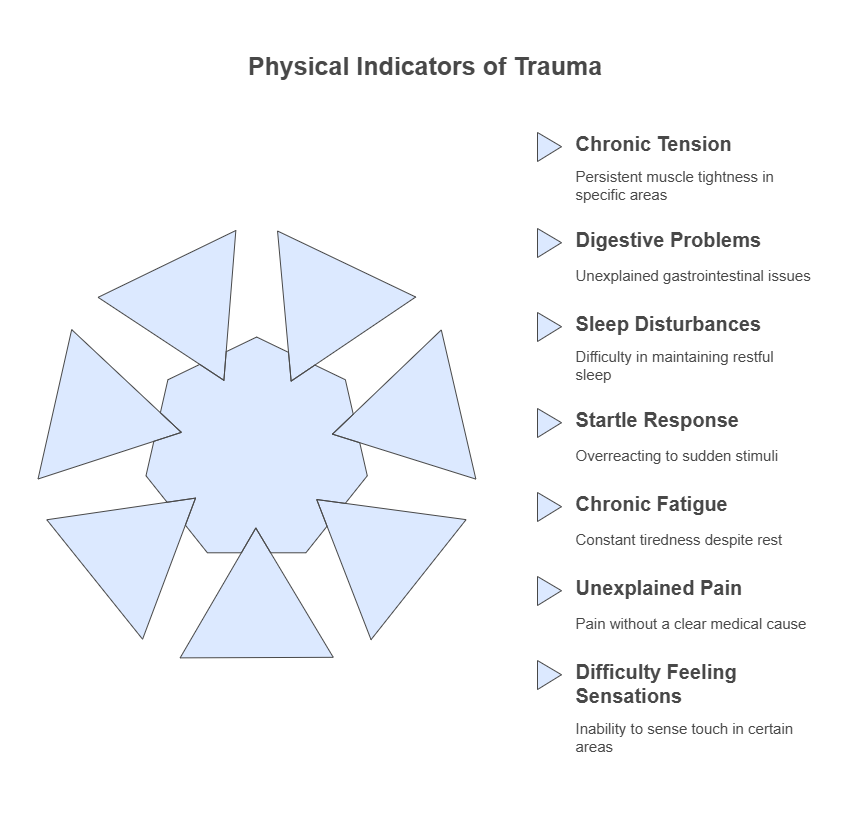
Signs of trauma in the body.
How Unresolved Trauma Shows Up in Men
Because men are often socialized to suppress emotion and “power through” pain, the signs of stored trauma can be subtle or misinterpreted.
| Common Manifestation | What It Looks and Feels Like |
|---|---|
| Hypervigilance / Anxiety | Constantly feeling on edge, scanning for danger, irritability, difficulty relaxing, sleep problems. |
| Hypo-arousal / Numbness | Feeling disconnected, empty, or "flat." A sense of watching your life from a distance. Difficulty feeling pleasure or joy. |
| Chronic Physical Symptoms | Unexplained pain (especially back and neck), digestive issues (IBS), headaches, and autoimmune disorders. |
| Addictive or Compulsive Behaviors | Using work, alcohol, drugs, porn, or other behaviors to numb or escape uncomfortable internal sensations. |
The Path to Healing: Somatic (Body-Based) Tools
Healing from trauma is not about “thinking” your way out of it. It’s about creating a sense of safety in your body and allowing the trapped survival energy to be released. Here are three evidence-based concepts from the world of somatic healing.
1.Pendulation: Finding Your Anchor
Developed by Dr. Peter Levine, pendulation involves gently shifting your attention between a place of discomfort or tension in your body and a place that feels neutral or even pleasant (an “anchor”). This teaches your nervous system that it can experience difficult sensations without being overwhelmed, gradually increasing your capacity to be with your experience.
2.Vagal Toning: Hacking Your Nervous System
The vagus nerve is the main highway of your parasympathetic nervous system—the body’s “rest and digest” system. According to Dr. Stephen Porges’ Polyvagal Theory, we can intentionally stimulate this nerve to send signals of safety to our brain (Porges, 2011). Simple exercises like deep, slow breathing (with a longer exhale), humming, or gargling can “tone” the vagus nerve, helping to bring you out of a state of anxiety or shutdown.
3.Titration: Healing in Small Doses
Titration means touching into the discomfort of the trauma for just a moment, then immediately returning to a place of safety and resource. This prevents the nervous system from becoming overwhelmed and allows the body to release small, manageable amounts of stored energy over time.
A Simple Practice: Therapeutic Humming
This exercise uses the vibration of your own voice to gently stimulate the vagus nerve and calm your nervous system.
1.Find a comfortable, seated position.
2.Close your eyes and take a few gentle breaths.
3.On your next exhale, begin to make a low, gentle “mmmm” sound, like a soft hum.
4.Pay attention to the vibration. Notice where you feel it in your chest, throat, and head.
5.Continue for 1-2 minutes, allowing the vibration to be a soothing, self-generated massage for your nervous system.
Conclusion: Your Body Is Your Ally
Your body is not the enemy. The symptoms of trauma are not a sign of weakness, but a sign that your body did exactly what it was supposed to do to help you survive. Healing is the process of gently and compassionately letting your body know that the danger has passed. By learning to listen to its language and use simple, body-based tools, you can begin the journey of releasing the past and reclaiming the safety and vitality that is your birthright.
References
Levine, P. A. (1997). Waking the tiger: Healing trauma. North Atlantic Books.
Porges, S. W. (2011). The polyvagal theory: Neurophysiological foundations of emotions, attachment, communication, and self-regulation. W. W. Norton & Company.
Van der Kolk, B. A. (2014). The body keeps the score: Brain, mind, and body in the healing of trauma. Viking.