Transforming the Brotherhood of Complicity
Beliefs (Rewrite Your Story) & Relationships (Rebuild Your Connections)
This article is a powerful exploration of the Beliefs that underpin harmful male norms and their direct impact on our Relationships. It deconstructs the unspoken “brotherhood code” that encourages silence in the face of wrongdoing, a core belief that must be rewritten. By examining this pattern, the article calls on men to build relationships grounded in accountability and integrity, rather than complicity. It is a critical resource for any man seeking to align his actions with his values and build a healthier, more honest form of masculinity.
Executive Summary
There’s an unspoken agreement between men: don’t call out another man, don’t break ranks, don’t make it awkward. This “Brotherhood of Complicity” is a silent pact that often leads good men to stay quiet in the face of harmful behavior. This article explores the roots of this code, from playground lessons to the fear of isolation, and reveals its true cost: diminished emotional range, shallow friendships, and a loss of personal integrity. Using real-world examples, it offers a non-shaming perspective on why this pattern exists and provides a clear, actionable path for men to find their voice, build authentic connections, and trade silent complicity for courageous accountability.

Key Takeaways
The “Brotherhood of Complicity” is a learned social script, not an inherent male trait. It can be unlearned.
Silence is a form of participation. When we stay silent in the face of harmful behavior, we implicitly condone it.
This pattern is not about being a “bad person.” It is often driven by a deep-seated, and understandable, fear of social rejection.
The cost of complicity is your integrity. Each act of silence creates a gap between your values and your actions, leading to internal conflict and shame.
Breaking the silence is a skill. It can be learned through small, consistent acts of courage, starting with emotional awareness and finding your voice in low-stakes situations.
Introduction: The Agreement You Never Signed
There’s an unspoken agreement between men that most of us never consciously agreed to, yet we often follow it. It’s a silent pact that can kick in when another man’s behavior crosses a line. We might call it the Brotherhood of Complicity, and it’s been operating in your life longer than you realize.
This isn’t about being a bad person. It’s about an invisible code we absorbed growing up, reinforced in countless small moments: Don’t call out another man. Don’t break ranks. Don’t make it awkward.
The tragic and high-profile case of Hannah Clarke and her three children in Australia provided a devastating look at this pattern at an institutional level. Despite a history of domestic violence and an active protection order, police officers were filmed coaching the perpetrator on how to challenge the order, a chilling example of male solidarity overriding professional duty (Queensland Domestic and Family Violence Death Review and Advisory Board, 2021). This instinct to protect, defend, or excuse another man’s harmful behavior plays out every day in ordinary moments. The stakes are usually lower, but the mechanism is identical.
When Have You Felt It?
I’ve sat through more uncomfortable moments than I can count. Times when a mate said something about his partner that made my stomach drop. Workplace conversations where the jokes crossed a line. I’d feel it physically first—a tightness in my chest, my gut telling me to speak up. But then another feeling would rush in: fear. Fear of being the one who ruins the vibe. Fear of being labeled “oversensitive.”
So I’d stay quiet. And each time, I’d feel a small piece of myself disappear—that gap between who I wanted to be and who I was actually being.
Maybe yours looks different:
The work lunch where someone jokes about “keeping his wife in line,” and you don’t laugh but you don’t say anything either.
The group chat where sexist memes get shared. You don’t forward them, but you don’t call it out.
The weekend game where your friend describes tracking his partner’s phone, and you nod along because challenging it feels too big.
In these moments, the Brotherhood of Complicity is doing its work. The question is: what’s it costing you?
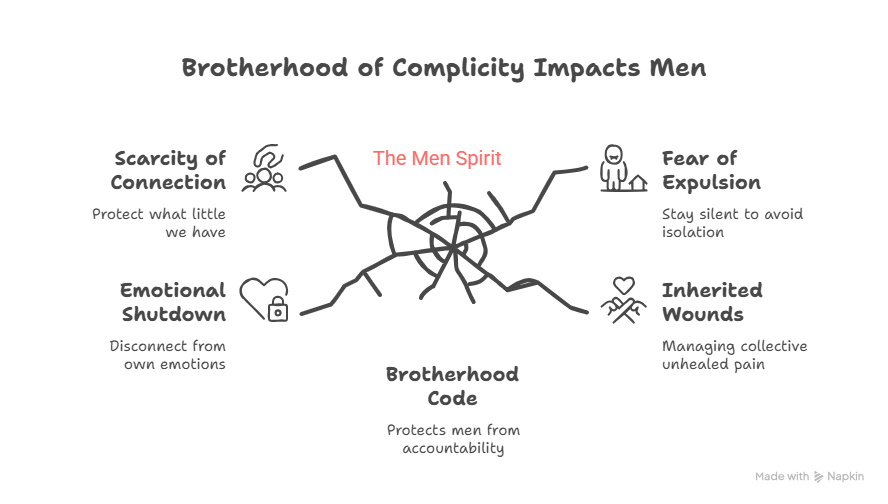
How is the Brotherhood of Complicity impacting men
Where Did This Come From? The Roots of Male Complicity
None of us were born believing we had to protect other men from accountability. These are learned behaviors, rooted in common male experiences:
•The Playground Lesson: We learned early that showing vulnerability got you targeted. Belonging required toughness, and toughness meant never questioning another boy’s dominance.
•The Emotional Shutdown: Most of us grew up watching men keep their feelings locked down, except for anger. As Dr. Brené Brown (2017) notes, when you’re taught to disconnect from your own emotions, it becomes nearly impossible to recognize or challenge someone else’s harmful behavior.
•The Scarcity of Real Connection: For many men, deep, emotionally honest friendships are rare. When male friendship feels scarce, we protect what little we have. The Brotherhood becomes a form of insurance: I won’t challenge you if you don’t abandon me.
•The Fear of Expulsion: Behind all of this sits a primal fear of being cast out and losing status. This fear triggers a defensive response whenever we consider breaking the code.
But what if this code that promises protection is actually a trap?
The True Cost of Complicity
The Brotherhood of Complicity doesn’t protect men—it diminishes us. It costs us:
• Our Emotional Range: It requires you to amputate most of your emotional life, leaving anger, numbness, or the performance of being “fine.”
• Real Friendship: It trades depth for superficial solidarity, leading to an epidemic of lonely men.
• Our Integrity: Every time you stay silent, you create a disconnect between your values and your actions. This accumulates as shame.
• Our Health: The emotional suppression and isolation the Brotherhood enforces are directly linked to higher rates of depression, anxiety, and suicide in men (Beyond Blue, 2020).

Breaking the Brotherhood of Complicity
A Different Kind of Strength: The Path to Accountability
This isn’t about shame. Shame keeps the cycle going. Most men are carrying beliefs and patterns that were handed to them. The men who inspire real change aren’t those who’ve never made mistakes; they’re the ones who decided to do something different, starting today.
1. Start with Emotional Literacy
You can’t challenge harmful behavior in others if you can’t recognize discomfort in yourself. Start a simple practice: a few times a day, pause and ask, “What am I actually feeling right now?” At first, the answer might be “fine” or “stressed.” But slowly, the vocabulary will expand. This is the foundation.
2. Find Your Voice in the Moment
The Brotherhood loses its power the moment you speak. Not with aggression, but with simple, honest truth.
•When a colleague makes a sexist joke: “I don’t find that funny.”
•When a mate describes controlling behavior: “That sounds rough for her. Have you thought about how she might be experiencing this?”
The first time you do this, your heart will race. But your voice creates space for other men who felt the same discomfort to find theirs.
3. Build Authentic Connection
The antidote to the Brotherhood of Complicity is authentic connection. Actively seek spaces where different rules apply—men’s groups, therapeutic settings, or structured conversations where vulnerability is valued, not punished. Sharing your struggles with trusted men doesn’t lead to expulsion; it leads to deeper belonging.
Conclusion: The Choice to Be a Man of Integrity
The Brotherhood of Complicity will keep operating as long as individual men choose silence over courage. But you have the power to choose differently. This isn’t about perfection. It’s about the commitment to keep choosing awareness, to keep finding your voice, to keep doing the work.
Your silence has always been a choice. Your voice is also a choice. And that choice, made consistently and courageously, is what builds the kind of male connection that actually serves everyone—including you.
References
Beyond Blue. (2020). The state of men’s health in Australia. Retrieved from Statistics - Beyond Blue - Beyond Blue
Brown, B. (2017 ). Braving the wilderness: The quest for true belonging and the courage to stand alone. Random House.
Queensland Domestic and Family Violence Death Review and Advisory Board. (2021). Annual Report 2020-21. Retrieved from Microsoft Word - DFVDRAB Annual Report 24-25 - FINAL